
Quickest way to Evict Travellers
Quality Bailiffs High Court Enforcement
Discovering an unauthorised traveller encampment on your private commercial land, development site, or vacant property can be a highly stressful experience. Beyond the immediate operational disruption, long-standing illegal occupations frequently result in severe property damage, fly-tipping, high clean-up bills, and immense intimidation for staff or local tenants.
When dealing with trespassers, taking quick action is always the most prudent approach. The longer an encampment remains on-site, the more established it becomes, and the higher the risk that additional vehicles and caravans will join the group.
If you are a landowner trying to secure your property, this guide outlines the primary legal avenues available in 2026, weighs the pros and cons of each method, and highlights why professional enforcement is essential.
While legislation such as the Police, Crime, Sentencing and Courts Act 2022 technically expanded law enforcement powers - making intentional unauthorised encampments under specific conditions a criminal offence - the practical reality on the ground is starkly different.
The lack of pro-active police support has become a major problem for UK private landowners.
In the vast majority of cases, police forces are stretched thin and heavily prioritize active crime over civil property matters.
When contacted about a traveller encampment on private land, the standard response from local authorities is often that “it is a civil matter”, leaving landowners to resolve the trespass independently.
Unless there is a severe breach of peace, criminal damage, or an immediate public safety risk, relying on the police to clear your land is rarely a viable or fast solution.
Consequently, landowners must take matters into their own hands using civil law pathways.
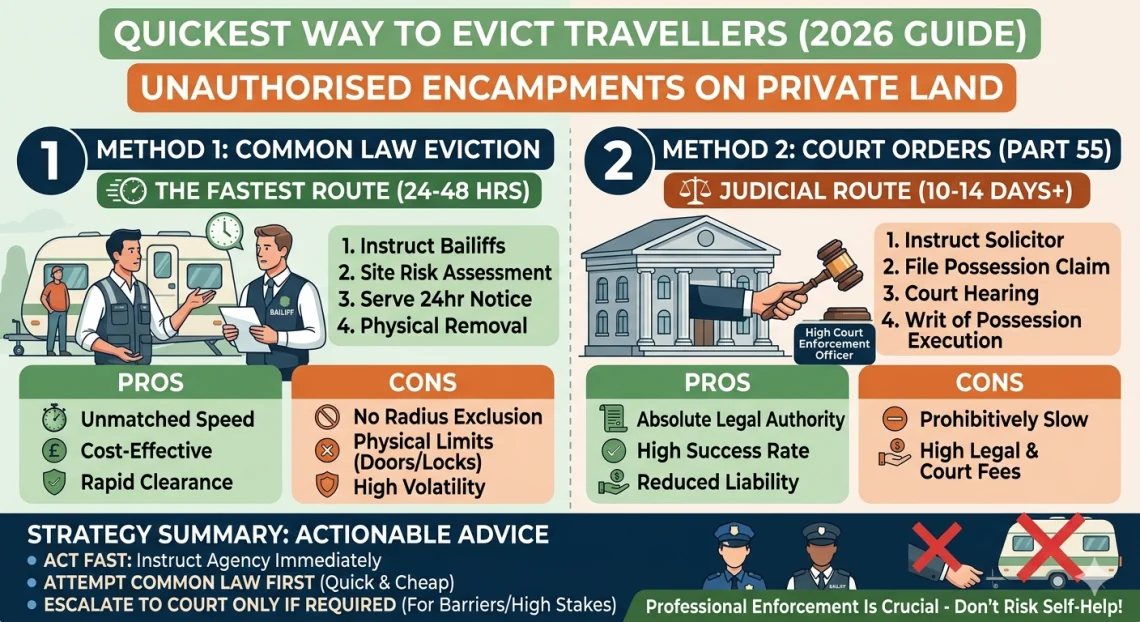
When comparing timelines, there are two primary legal methods available to private landowners: Common Law Eviction and Court Orders under Part 55 of the Civil Procedure Rules.
Below is an objective analysis of the pros and cons of each route to help you determine the most effective strategy for your situation.
Under long-standing English Common Law, a property owner has the inherent right to remove trespassers from their land without a court order. Landowners typically delegate this power to a Certificated Enforcement Agent (Bailiff).
This method involves applying directly to the County Court or High Court for an official Possession Order. Once granted, the order is executed via a Writ of Possession by High Court Enforcement Officers (HCEOs).
Given the delays of courts and the absence of rapid police attendance, some landowners consider serving their own notices or blocking access themselves. This is highly discouraged.
Serving a notice yourself exposes your internal employees to severe health and safety risks and can invalidate your corporate public liability insurance if a confrontation occurs. Furthermore, illegal occupants are fully aware of property laws; they recognize that a private individual cannot legally execute physical force, meaning self-served notices are routinely ignored.
Utilising a professional enforcement firm guarantees compliance with the Health and Safety at Work Act 1974 via certified risk assessments, body-worn cameras, and specialist conflict management training.

If you require the quickest way to evict travellers on unauthorised encampments, your strategy should always be structured as follows:
Quality Bailiffs are available to advise and to perform trespasser, Gypsy and Traveller eviction services.
If you need help with a trespasser, Gypsy or Traveller eviction, then contact your local regional office.
This article was written by Andrew Coates, Authorised High Court Enforcement Officer and full member of The High Court Enforcement Officers Association, and current CEO of Quality Bailiffs.
Andy has a Level 4 diploma in High Court Enforcement, and over twenty five years of experience in the bailiff and investigation industry. He is a former governing council member of both CIVEA and ABI.
Disclaimer
This article provides general information and does not constitute legal advice. It is essential to consult with a qualified legal professional for advice tailored to your specific circumstances.
read more eviction articles


Southern Region
| Southampton |
| 023 8192 0037 |
| southern@qualitybailiffs.co.uk |
Midlands Region
| Birmingham |
| 0121 582 1051 |
| midlands@qualitybailiffs.co.uk |
Northern Region
| Manchester |
| 0161 791 1735 |
| northern@qualitybailiffs.co.uk |
Southern Local Areas
| Bristol |
| Brighton |
| Canterbury |
| Maidstone |
| Reading |
Midlands Local Areas
| Cardiff |
| Derby |
| Leicester |
| Peterborough |
| Sheffield |
| Shrewsbury |
Northern Local Areas
| Carlisle |
| Darlington |
| Leeds |
| Middlesbrough |
| Newcastle |