
Transfer Possession Order to High Court Writ of Possession

2026 How to Guide for landlords who wish to do the transfer themselves
If you’re a landlord or letting agent staring down a months-long County Court bailiff waiting list while a tenant remains in your property, you don’t have to simply wait it out.
Section 42 of the County Courts Act 1984 allows you to ‘transfer up’ your possession order to the High Court, where a High Court Enforcement Officer can enforce it by Writ of Possession — often within days rather than months.
This guide sets out, step by step, the quickest way to transfer your possession order to the High Court in 2026: the letters you must send, the court application itself, and the final application for the Writ of Possession — plus how a fixed-fee professional service can take the whole process off your hands.
The Core Challenge: County Court Bailiff Delays
Once a judge grants a possession order, most landlords assume the property will be back in their hands within a few weeks. In reality, County Court bailiff waiting lists in many parts of England and Wales — particularly London and the South East — regularly run to several months.
Every week of delay means more lost rent, more arrears, and in many cases continued nuisance, disturbance, or damage caused by an occupier who has already been ordered to leave.
Because County Court bailiffs are shared across every type of civil enforcement in that court, there is very little a landlord can do to speed up their allocated appointment. Fortunately, the law provides an alternative route that takes enforcement out of the County Court queue altogether.
What Does ‘Transferring Up’ Actually Mean?
‘Transferring up’ is the process of asking the County Court for permission, under Section 42 of the County Courts Act 1984, to move enforcement of your possession order from a County Court bailiff to a High Court Enforcement Officer. Once that permission is granted, a separate application is made to the High Court for a Writ of Possession, which the HCEO then executes.
Because HCEOs work to their own schedule rather than a shared court list, enforcement can typically be arranged in a matter of days once the writ is sealed — which is why transferring up has become the standard route for landlords who can’t afford to wait.
The Quickest Way to Transfer a Possession Order to the High Court: Step-by-Step
Step 1: Send Notice Letters to the Defendant and the Occupier
Before applying to the Court, you must send two separate letters — one to the named defendant and one to ‘the occupier’, in case they are different people — giving formal notice of your intention to apply to transfer enforcement under Section 42(2) and, subsequently, to apply to the King‘s Bench Division for a Writ of Possession under CPR 83.13.
This notice is treated as sufficient in itself; separate service of the application notice is not required (see Gupta v Partridge [2017]). Put the letters on your own headed paper — or, if you are a litigant in person, include your own name and address instead.
Step 2: Prepare Your N244 Application, Witness Statement and Court Letter
Your application to transfer up is made using Form N244 — the same form used for most County Court applications, but this time requesting leave under Section 42 to transfer enforcement to the High Court. You’ll need to submit it together with:
- A signed cover letter to the Court
- The completed N244 application notice (original plus 2 copies)
- A detailed witness statement
- A draft of the Order you are requesting (plus 2 copies)
- Any relevant supporting evidence
A detailed witness statement is the single biggest factor in whether an application succeeds. The majority of transfer-up applications that are rejected fail because the judge simply isn’t given enough evidence of delay or hardship. Useful supporting evidence includes:
- A sealed copy of the original possession order
- The tenancy agreement, where arrears are relevant
- An up-to-date schedule of rent arrears
- Evidence of your financial loss (rental valuation, mortgage statement, etc.)
- Correspondence with the County Court bailiff service confirming the delay
- Evidence of nuisance or damage — photos, repair invoices, neighbour complaints
- Copies of the notice letters sent to the defendant and occupier
Step 3: The Court Grants Permission (the Section 42 Order)
Assuming the judge is satisfied that transfer is appropriate — typically because of bailiff delay, ongoing arrears, or risk to the property — the Court will grant an order under Section 42 giving you permission to transfer enforcement to the High Court.
Step 4: Apply for the Writ of Possession
With your Section 42 order in hand, the next step is to apply for the Writ of Possession itself, at the relevant District Registry of the High Court. Under CPR 30.4(3), the application defaults to the District Registry covering the geographic area in which the property is located.
Two forms are required:
- Form PF92A – the request to issue the writ.
- Form 66 – the Writ of Possession itself, which is made out to the named High Court Enforcement Officer who will carry out the eviction.
A court fee (currently £82) must be paid at the same time the forms are submitted.
Step 5: The HCEO Executes the Writ
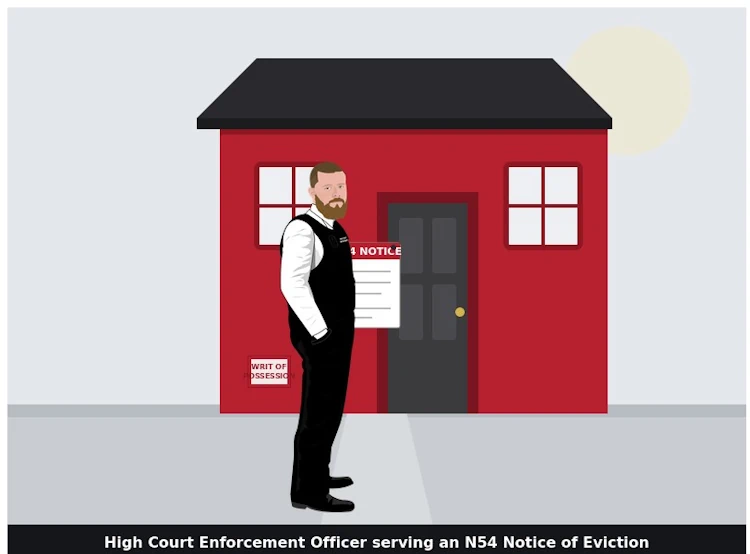
Once the Writ of Possession is sealed, it’s passed to the High Court Enforcement Officer, who will typically give the required notice period and then attend to enforce it — recovering possession of your property far faster than the County Court bailiff route would have allowed.
DIY or Fixed-Fee Professional Support?
Every stage above can be handled by a landlord or agent directly, using court-approved templates for the notice letters, the N244 application, the letter to the Court, and the witness statement.
Because these applications are frequently rejected on paperwork or evidence grounds, it pays to be thorough — or to have someone experienced check the paperwork before it’s submitted.
Summary Verdict: Your Fastest Route to Possession
- Check your position with the County Court bailiff service straight away and keep a written record of any delay they confirm.
- Send the two notice letters to the defendant and occupier without delay.
- Submit your N244, witness statement and letter to the Court, backed by strong evidence of delay or hardship.
- Once permission is granted, move immediately to Form PF92A and Form 66 at the correct District Registry, and pay the £82 court fee.
- Instruct a High Court Enforcement Officer to execute the writ
— or ask our partner solicitor company to manage the whole transfer for a fixed £250 + VAT fee.
We Can Help
Quality Bailiffs can act as your High Court Enforcement Officer to execute the Writ of Possession once permission has been granted,
and our partner solicitor company can manage the transfer up application and/or the permission application for you.
If you need help transferring a possession order to the High Court, contact your local regional office:
0208 090 2439
023 8192 0037
0121 582 1051
0161 791 1735
About the author
This article was written by Andy Coates, Authorised High Court Enforcement Officer and full member of The High Court Enforcement Officers Association, and current CEO of Quality Bailiffs.
Andy has a Level 4 diploma in High Court Enforcement, and over twenty five years of experience in the bailiff and investigation industry. He is a former governing council member of both CIVEA and ABI.
Disclaimer
This article provides general information and does not constitute legal advice. It is essential to consult with a qualified legal professional for advice tailored to your specific circumstances.
More Articles
- Transfer a Possession Order to the High Court for Faster Enforcement
- Commercial and Residential Property Eviction in England and Wales
- Residential Evictions: How-to Guide 2026
read more property eviction articles


