
Using a Bailiff - how to guide
Quality Bailiffs High Court Enforcement
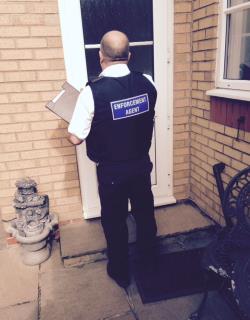
In this updated article Andrew Coates, one of our Authorised High Court Enforcement Officers, will explain the different types of Bailiff, when it is appropriate to use one, and how to instruct them.
Most people never have dealings with a High Court Enforcement Officer, a Bailiff, or an Enforcement Agent, as we are now called. Consequently, when they need to reclaim money or reclaim property, they are not sure which type of bailiff to use or how to instruct one.
There are usually three main reasons that you may want to use a bailiff:

There are currently three types of bailiff that deal with these types of cases in England & Wales.

Certificated Enforcement Agents (Bailiffs) are appointed by the court but do not work directly for the court.
They were formally known as Certificated Bailiffs and are the most common type of bailiff.
They are often featured on the television programs such as the BBC’s Sheriffs are Coming.
They work for members of the public via the Private Enforcement Agencies, High Court Enforcement Officers and Local Authorities.
When you have a court judgment for over £600 or possession claim Certificated Enforcement Agents (bailiffs) can execute writs of control and possession. This can only happen if they are authorised by a High Court Enforcement Officer. The main ones have a Director that sits on the board of Directors. Here at Quality Bailiffs we have two Authorised Officers listed with the High Court Officers Association.
Some of the other Enforcement Agencies have an arrangement for remote supervision with a High Court Enforcement Officer.

At the time of writing there are currently 44 High Court Enforcement Officers in England and Wales.
When enforcing a County Court Judgment in England and Wales if the judgment is below £600 inclusive of costs then you MUST use the County Court’s own bailiffs.
If the judgment is above £600 you can have your case transferred up from the County Court where you got your Judgment to the High Court for enforcement.
This process is called transferring and the law says that the execution of the writ (warrant) must be completed by a qualified and Certificated Enforcement Agent (formally Bailiff) who is under the supervision of a High Court Enforcement Officer (HCEO).
High Court Enforcement Officers are very experienced and well qualified individuals who are authorised by the Lord Chancellor to execute judgments and transfer cases up to the High Court. They sit between members of the public and the bailiffs that they employ or contract to.
Their duty is to be even handed between debtor and creditor and simply enforce the Writ according to the law. That way they ensure the conduct of the file through to enforcement or another conclusion. How to Use a High Court Enforcement Officer gives further details.
County Court Bailiffs are salaried civil servants that work for the Ministry of Justice, with a couple usually assigned to each local County Court.
They undertake:
Professional Certificated Enforcement Agents should be members of a recognised trade association and carry both professional indemnity insurance and public liability insurance.
The two main trade associations are:
Some bailiffs are members of more than one association.
Some bailiffs are also investigators and members of the Association of British Investigators, ABI
Unless you are a commercial landlord or have problems with trespassers on land you cannot instruct a bailiff or High Court Enforcement Officer without first of all gaining a court order or judgment.
If you require a recommendation to a specialist solicitor that can gain this for you then please contact us and ask for details of solicitor from our panel of approved solicitors.
The answer to this all depends on what you want them to do.
For collecting money and they are successful then usually free.
For Evictions it depends on the type of property or land, the size of the eviction and number of people involved.
Need help? Call your local regional centre for free advice.
From 1 May 2026, changes to enforcement regulations and fee structures governing Enforcement Agents (commonly known as bailiffs) and High Court Enforcement Officers in England and Wales will come into effect following government reform of the sector.
Key changes include:
The Enforcement Conduct Board (ECB), which was originally established through a partnership between the debt advice sector and the enforcement industry, will receive statutory underpinning at some stage.
At that point all enforcement firms will be required to be licensed and regulated by the ECB, including the enforcement agents they employ.
The compulsory use of Body Worn Video (BWV) by Certificated Enforcement Agents will be introduced at some point. This measure is intended to improve transparency, accountability, and public confidence in enforcement activity.
A revised fee structure will apply from 1 May 2026, including:
The statutory Notice of Enforcement period will be extended:
From 1 May 2026, enforcement fees recoverable under the Taking Control of Goods (Miscellaneous Amendments) Regulations 2026 will be revised. The structure retains the existing staged approach, with updated fixed fees and revised thresholds for percentage based fees.
The new fees are:
For non-High Court debts (including County Court judgments, council tax, parking penalties and similar liabilities), the Taking Control of Goods (Fees) Regulations will continue to apply with revised amounts and thresholds from 1 May 2026.
The recoverable enforcement fees will be:
The revised fees apply only to enforcement action commencing on or after 1 May 2026; cases already underway before that date will remain subject to the previous fee structure.
This article was written by Andrew Coates, Authorised High Court Enforcement Officer and full member of The High Court Enforcement Officers Association, and Current CEO of Quality Bailiffs.
Andy has a Level 4 diploma in High Court Enforcement, and over twenty five years of experience in the bailiff and investigation industry. He is a former governing council member of both CIVEA and ABI.
read more industry news


Southern Region
| Southampton |
| 023 8192 0037 |
| southern@qualitybailiffs.co.uk |
Midlands Region
| Birmingham |
| 0121 582 1051 |
| midlands@qualitybailiffs.co.uk |
Northern Region
| Manchester |
| 0161 791 1735 |
| northern@qualitybailiffs.co.uk |
Southern Local Areas
| Bristol |
| Brighton |
| Canterbury |
| Maidstone |
| Reading |
Midlands Local Areas
| Cardiff |
| Derby |
| Leicester |
| Peterborough |
| Sheffield |
| Shrewsbury |
Northern Local Areas
| Carlisle |
| Darlington |
| Leeds |
| Middlesbrough |
| Newcastle |