
Commercial Rent Arrears & Insolvency
Commercial landlords and tenants alike face unique challenges when dealing with commercial rent arrears and insolvency.
These interconnected issues can create significant financial strain and legal complexities.
This article explores the key considerations for both parties, offering insights into navigating these difficult situations.
Understanding the Interplay: Commercial Rent Arrears & Insolvency
Commercial rent arrears arise when a tenant fails to pay rent as agreed in their lease. This can be a temporary cash flow issue or a sign of deeper financial distress.
Insolvency occurs when a business is unable to meet its financial obligations, potentially leading to administration, liquidation, or a Company Voluntary Arrangement (CVA).
The connection is clear:
- Persistent rent arrears can be a major contributing factor to a tenant’s insolvency.
- Whilst a tenant’s insolvency significantly impacts a landlord’s ability to recover outstanding rent.
For Landlords: Protecting Your Interests
When faced with commercial rent arrears, landlords need to act swiftly and strategically to minimise losses. Here are some crucial steps:
Communication: Initiate open communication with the tenant to understand the reasons for the arrears and explore potential solutions.
Formal Demand: Issue a formal written demand for the outstanding rent, clearly outlining the amount owed and the consequences of non-payment.
Important. Do not issue a payment demand if you are considering forfeiture as you may waive your right to forfeit the lease.
Commercial Rent Arrears Recover (CRAR): Commercial Rent Arrears Recovery (CRAR) is a legal procedure that allows commercial landlords to recover rent arrears from tenants without having to go to court. It came into force in 2014, replacing the old system of distraint.
Insolvency Proceedings
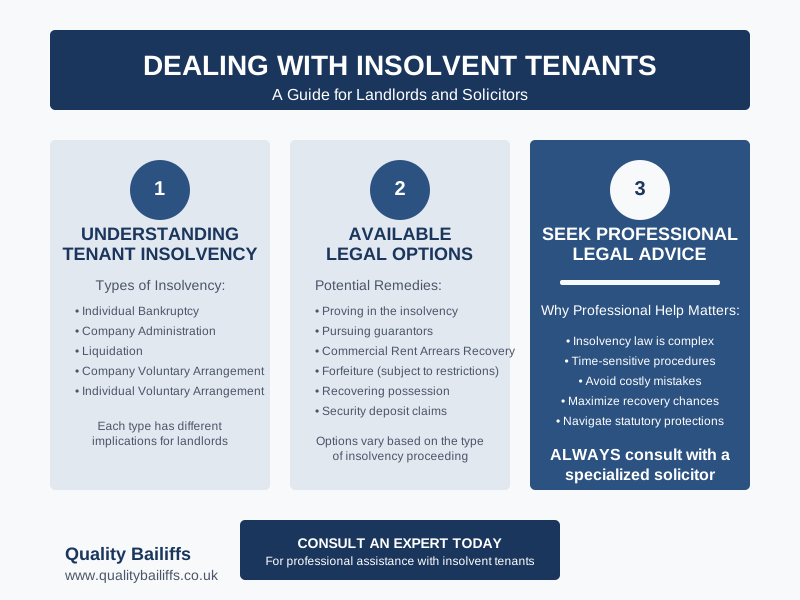
If the tenant becomes insolvent, landlords must engage with the insolvency practitioner to protect their interests and claim for outstanding rent. This may involve proving their debt and understanding the implications of different insolvency procedures.
Dealing with main types of Tenant Insolvency
Administration: Administrators are appointed to manage the company's affairs and may seek to sell the business as a going concern. Rent arrears accrued before administration are unsecured debts. Rent accruing during administration may be treated as an expense of the administration, offering a higher chance of recovery.
Liquidation: Liquidators are appointed to wind up the company and distribute assets to creditors. Landlords are unsecured creditors for rent arrears accrued before liquidation.
Company Voluntary Arrangement (CVA): A CVA is a formal agreement between a company and its creditors to repay debts over a period of time. Landlords will be bound by the terms of the CVA if it is approved by the required majority of creditors.
Enforcement Options for Dealing with Insolvent Tenants

Conclusion
Commercial rent arrears and insolvency are complex issues that require careful consideration and strategic action.
Open communication, professional advice, and a thorough understanding of the legal framework are essential for both landlords and tenants to navigate these challenges effectively.
By taking pro-active steps, both parties can minimise financial losses and work towards a mutually agreeable solution.
How CRAR works
Rent Arrears: The tenant must be in arrears with their rent by at least seven days pure rent only.
Notice of Enforcement: The Enforcement Agent (Bailiff) must serve the tenant with a formal “Notice of Enforcement” giving them at least seven days' notice that they intend to recover the arrears using CRAR.
Seizure of Goods: If the tenant doesn’t pay the arrears within the notice period, the enforcement agent can enter the commercial premises and seize goods belonging to the tenant up to the value of the debt.
Sale of Goods: The enforcement agent will then sell the seized goods at auction to raise the money to pay the rent arrears, plus their fees and costs.
Key points to remember about CRAR
- Commercial Property Only: CRAR only applies to commercial property, not residential.
- Written Lease: There must be a written lease agreement in place.
- Tenant in Occupation: The tenant must still be in occupation of the property.
- Authorized Agent: Only authorized enforcement agents can carry out CRAR.
- 7-Day Notice: The tenant must be given at least seven days' notice before any goods are seized.
- Goods belonging to Tenant: The enforcement agent can only seize goods that belong to the tenant.
- Sale of Goods: The goods must be sold at auction, and the tenant must be given notice of the sale.
Advantages of CRAR
- Faster and Cheaper: CRAR is generally faster and cheaper than going to court to recover rent arrears.
- Less Disruptive: CRAR can be less disruptive to the tenant's business than court action.
- Effective: CRAR can be an effective way to recover rent arrears.
Disadvantages of CRAR
- Limited to Rent Arrears: CRAR can only be used to recover rent arrears, not other debts.
- Tenant Cooperation: CRAR relies on the tenant having goods that can be seized and sold.
Forfeiture (Peaceable Re-entry)
Forfeiture, in the context of commercial leases, is a legal right that allows a landlord to terminate a lease and repossess the property if the tenant breaches the lease agreement. This most commonly occurs due to non-payment of rent, but can also be triggered by other breaches. For example:
- Failure to repair: If the tenant is responsible for repairs and fails to do so.
- Unauthorised alterations: Making changes to the property without the landlord’s consent.
- Subletting without permission: Granting a sublease without the landlord’s approval.
Peaceable re-entry is one of two methods by which a landlord can forfeit a lease. It involves the landlord’s Bailiff physically re-entering the property and taking possession without the need for a court order. This is typically done by changing the locks while the property is vacant.
Key aspects of peaceable re-entry
- Legality: It must be done "peaceably," meaning without the use of force or violence.
- Lease terms: The lease must specifically allow for forfeiture by peaceable re-entry.
- Vacant possession: The property must be vacant at the time of re-entry. It cannot be used as a residence.
Advantages of peaceable re-entry
- Speed: It can be a quicker way to regain possession than going through the courts.
- Cost: It’s generally less expensive than court proceedings.
Disadvantages of peaceable re-entry
- Risk of challenge: If the tenant can prove the re-entry was not “peaceable” or that the lease didn’t allow for it, they could challenge the forfeiture in court.
- Potential for liability: If done incorrectly, the landlord could face claims for trespass or unlawful eviction.
read more about the Commercial Rent Arrears Recovery service
read more about the Lease Forfeiture service
Problems with commercial tenants?
Contact Quality Bailiffs.
0208 090 2439
023 8192 0037
0121 582 1051
0161 791 1735
About the author
This article was written by Andrew Coates, Authorised High Court Enforcement Officer and full member of The High Court Enforcement Officers Association, and current CEO of Quality Bailiffs.
Andy has a Level 4 diploma in High Court Enforcement, and over twenty five years of experience in the bailiff and investigation industry. He is a former governing council member of both CIVEA and ABI.
Disclaimer
This article provides general information and does not constitute legal advice. It is essential to consult with a qualified legal professional for advice tailored to your specific circumstances.
More Articles
- Does the filing of an N244 Stay Enforcement?
- How to collect service charges for commercial property.
- CRAR Notice of Enforcement / Binding.
- What can we do about the goods left behind after a forfeiture?
read more crar news articles


